Colon hydrotherapy is one of the treatments people phone us about most, and one of the least openly discussed. Almost everyone arrives with the same two questions: what actually happens in that room, and does it work. This guide answers both as plainly as we can, including the parts the usual advertising leaves out.
In short
- Colon hydrotherapy is a gentle washing of the lower bowel with warm, purified water. A session takes 30 to 45 minutes.
- Every session at Medilution uses a factory sealed, single use kit, opened in front of you.
- The research is still limited. Some people find a session eases bloating and the feeling of heaviness, but there are no long term trials.
- It is not a replacement for seeing a doctor about a change in your bowel habit.
- It does not suit everyone, which is why every session starts with a health check.
What colon hydrotherapy actually is
Colon hydrotherapy is the gentle flow of warm, filtered, temperature controlled water into the large intestine. You may hear it called a colonic, a colon cleanse or colonic irrigation. They all describe the same thing.
It works only in the lower bowel. That is the main difference between hydrotherapy and oral laxatives, which pass through the stomach and small intestine first. During a session the water goes in slowly and at low pressure, and water and waste leave through a closed tube, so nothing is open to the room.
You will also see it advertised as a way to clear the body of waste supposedly built up over years, or to lift energy and clear the mind. Those are not claims we make. There is no good research behind them, and a clinic run by a doctor should say so rather than repeat them.
Why people come to see us
Most people book a session after a long stretch of sluggish digestion. The reasons they give us are usually the same handful: bloating, a heavy or uncomfortable feeling in the abdomen, acid discomfort, or constipation that diet changes alone have not shifted.
Those are the reasons people come. They are not promises about what the treatment will do, and the next two sections explain why we draw that line carefully.
See a doctor first if
Please have a medical assessment before booking any treatment if you have blood in your stool or bleeding from the bottom, stool that looks black or dark red, a sudden change in your bowel habit that has not settled, ongoing tummy pain, weight loss you cannot explain, or constant tiredness alongside bowel symptoms. Changes in bowel habit have many causes, and some of them need a diagnosis rather than a treatment. CANSA recommends bowel screening from the age of 50 in South Africa, and earlier for anyone with symptoms or a family history. If you are bleeding heavily and it will not stop, go to your nearest emergency department, or phone 10177, or 112 from a mobile.
What happens in a session
A health check comes first
Every patient completes a health assessment before anything else. This is where we find out whether the treatment is suitable for you at all, and it is the reason the first appointment is a conversation rather than a procedure.
A private room
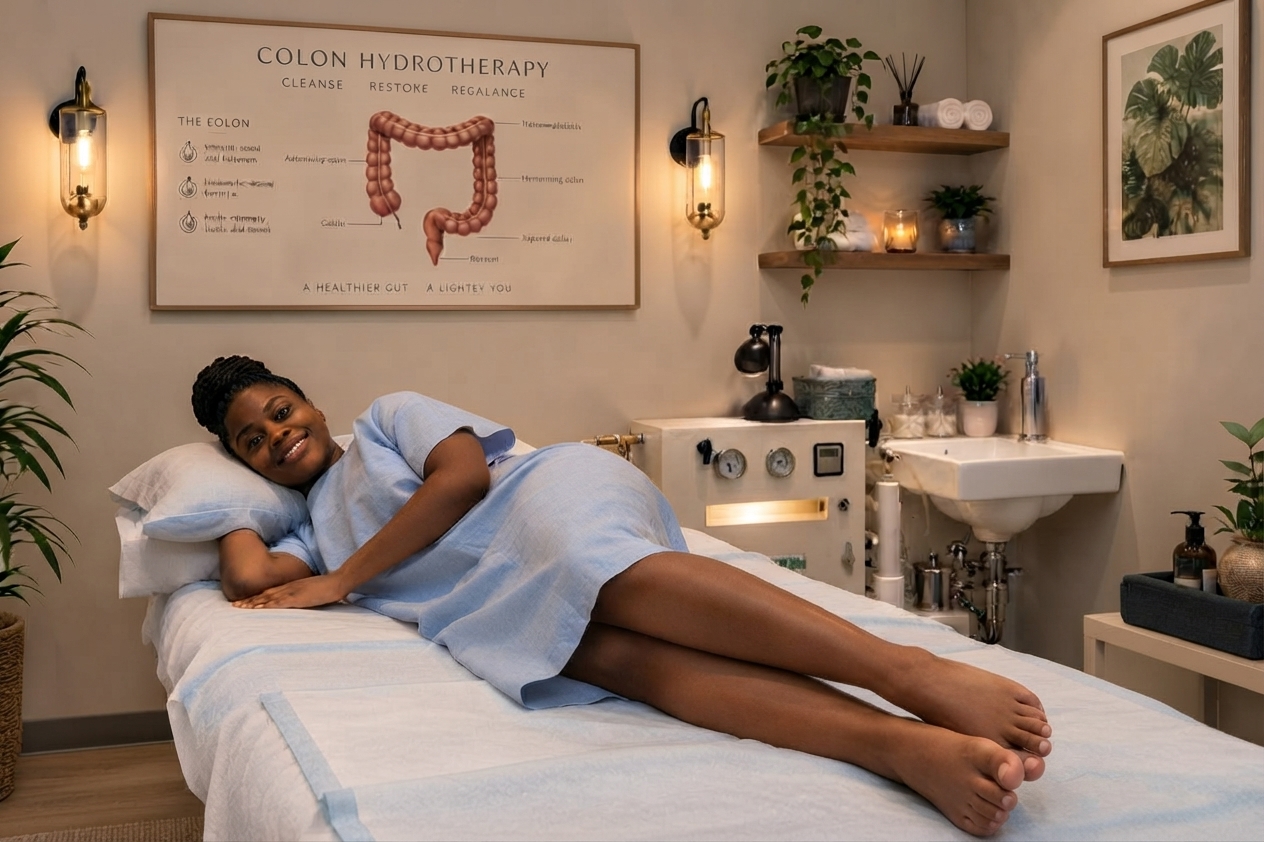
You are shown to a private treatment room, change into a gown and lie on a cushioned couch. Nobody else is in the room apart from the therapist.
The kit is opened in front of you
We use a brand new, factory sealed, single use kit for every patient, and it is opened where you can see it. It is discarded straight after your session.
The water
A small speculum tube is inserted, and warm, purified water enters slowly at low pressure. Most people feel a sensation of fullness, much like needing the toilet. The therapist controls the temperature and pressure throughout, and you can ask them to stop at any point.
Afterwards
When the session is finished you move through to the adjoining toilet to empty your bowel properly. The whole appointment runs 30 to 45 minutes.
What the research does and does not show
This is the part most clinics skip, so here it is directly. Colon hydrotherapy has been studied, but not well enough yet to promise anyone a result.
A 2026 review in the journal Gastrointestinal Disorders looked at colon hydrotherapy and the related technique of transanal irrigation for long term constipation. The authors describe them as options that may sit alongside first line treatment, or be considered when the usual approaches have not worked. In the same review they are clear that there is not yet enough scientific data on the subject, that there are no long term randomised trials of colon hydrotherapy, and that practice varies widely between clinics in water volumes, pressures and equipment.
So what can honestly be said? Some people tell us they feel lighter and less bloated after a session. Researchers are still working out whether that holds up over time and for whom. Until that work is done, we would rather you came in knowing the evidence is early than leave believing something we cannot stand behind.
The same review is useful on safety. It notes that serious problems are rare but real, and that they are most likely where the patient’s history has not been properly assessed or the equipment is handled by someone untrained. That is precisely why we take a history first and why the therapist, not the machine, controls the session.
Thinking about colon hydrotherapy?Phone either branch and we will tell you honestly whether it is suitable for you, or whether something else would serve you better.
Talk to usWho it is not for
Colon hydrotherapy is not suitable if you have severe active haemorrhoids, a tear in the bowel, severe ulcerative colitis, Crohn’s disease, recent abdominal surgery or severe heart disease, or if you are pregnant.
That list is not exhaustive, and it is not a form for you to tick yourself. Bring your full medical history and any medicines you take to the health check, including anything you have been prescribed elsewhere. If the treatment is not right for you, we will say so, and other treatments we offer may suit you better.
Getting ready, and the rest of your day
Eat light meals on the day of your appointment, and avoid heavy or greasy food in the two hours beforehand.
Afterwards you can drive yourself home or go back to work. Drink plenty of water through the rest of the day and keep your food light. Most people carry on as normal.
Questions we get asked
Is the equipment clean?
Every treatment uses a factory sealed, single use disposable kit. It is opened in front of you and discarded immediately after your session. Nothing is reused between patients.
Is it painful?
It should not be. Most people feel mild pressure as the water enters, similar to the urge to go to the bathroom. Tell the therapist if anything is uncomfortable, because they control the flow and can stop at any point.
Can I drive home afterwards?
Yes. You can drive and get on with your normal day straight away.
How many sessions will I need?
That depends on you, and it is decided with you at the health check rather than sold to you in advance. Some people come once for comfort. Others choose a short series.
Can it replace seeing a doctor about constipation?
No. Constipation that is new, persistent or getting worse needs a medical assessment, because the cause matters. Colon hydrotherapy sits alongside medical care, never instead of it. Dr Mthembu sees patients at both branches.